
For Couples Rebuilding After Betrayal
Your Body Remembers What Your Mind Is Trying to Release
When betrayal fractures trust, healing your heart isn't enough. Your nervous system needs its own path back — and so does your intimacy.
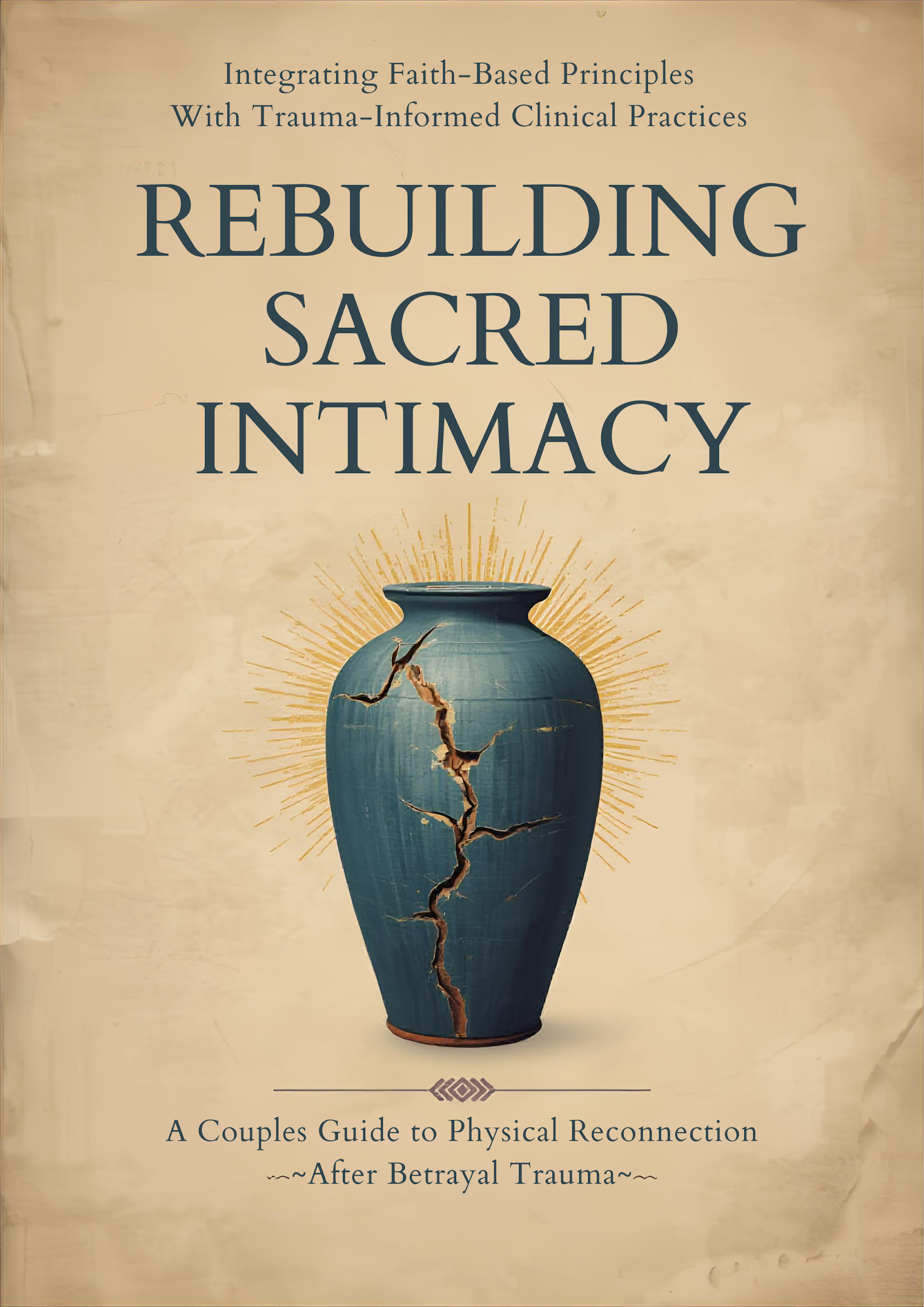
You've tried everything.
The counseling. The conversations. The commitment to "moving forward." And still — something in your body won't let go. Not because you're doing it wrong. Because your body is solving a different problem than your mind is.
“I want to want him again. But when he reaches for me, something inside freezes. I hate that I can't control it.”
— The freeze response“We've done the hard work of rebuilding trust. So why does physical intimacy still feel like walking through a minefield?”
— The trust-body gap“I'm exhausted from trying to explain what I need when I don't even understand why I'm reacting this way.”
— The language wall“Some days I think we're healing. Then a song, a scene, a shadow of a memory — and I'm right back in the pain.”
— The ambush trigger
What the Advice Keeps Missing
You took the advice seriously.
Forgive — and the intimacy will come back.
Trust the process — healing takes time.
Pray about it — God will restore what's broken.
None of this was wrong. You did the counseling. Read the books. Showed up to the hard conversations even when everything in you wanted to hide. And some things did heal — the conversations got easier, the trust started rebuilding, the worst of the crisis passed.
But your body didn't get the memo.
He reaches for you and something shuts down. You want to want him — and you can't make yourself feel safe. The advice says you should be further along by now. So you perform closeness you don't feel, or you avoid it entirely, and either way you end up in the same place: wondering what's wrong with you.
Nothing is wrong with you.
The advice you've been given addresses your heart, your faith, and your commitment. It assumes that if you heal emotionally, physical intimacy will follow.
That assumption is the gap. And every week you spend trying harder at the wrong thing is another week your body stays locked in protection mode — while you blame yourself for not being "healed enough."
Because this was never just about your heart.
We Didn't Find This in a Textbook

We're Chris and Kathy. We write about rebuilding intimacy after betrayal because we've lived on both sides of it — the betrayed partner's devastation and the unfaithful partner's repentance.
We won't share every detail here. Some wounds are sacred. But we will tell you this:
The months after discovery were the hardest either of us has ever lived. There were days we couldn't be in the same room. Nights we couldn't sleep apart. Moments when the only prayer we could manage was one word: Help.
We did the counseling. Read the books. Prayed the prayers people told us to pray. Some of it helped — but none of it reached the place where we were actually stuck.
The heart had forgiven. The body hadn't received the message.
Every time we reached for each other, something inside still flinched. Still braced. Still froze. And nobody was talking about that.
We spent nearly a year looking for one resource that addressed all of it — the faith, the trauma, the science, and the physical reconnection. What we found instead: faith resources that skipped the body entirely. Clinical approaches that understood the trauma but stripped out the sacred. Marriage books that weren't built for this level of devastation.
Nothing integrated all of it. So we stopped searching and started building. You can read the longer version of our story here.
What Your Body Is Trying to Tell You
What you're experiencing has a name. It's called betrayal trauma.
And your nervous system is doing exactly what it was designed to do — protecting you from what it still perceives as a threat.
The hypervigilance that won't let you relax. The emotional flooding that comes out of nowhere. The dissociation during intimacy — the way your body goes rigid or numb when your heart wants to connect.
These aren't character flaws. They're not evidence that you haven't really forgiven. They're survival responses — your body's way of saying: I don't feel safe yet. We cover this in depth in what betrayal trauma feels like in your body.
This isn't a faith problem. It's a wiring problem.
Your nervous system doesn't respond to theology alone. It responds to safety. And the path to rebuilding physical intimacy runs through your body's threat-detection system — not around it.
The strategies that work for rebuilding emotional trust are different from the strategies needed to rebuild physical safety. Your heart needs one path. Your body needs another. And until both paths are honored, the gap between "I've forgiven" and "I feel safe enough to be close again" stays open.
But here's what that also means: this isn't permanent.
If what you're experiencing is a nervous system response — not a spiritual failure — then there is a way forward. Not by trying harder. Not by praying harder. By learning a structured, self-guided practice — informed by polyvagal research and built for the kitchen table. One that gives your body language for what it's doing, and a way to work with it instead of against it.

金継ぎ
Kintsugi
In Japan, there's an ancient art called kintsugi — the practice of repairing broken pottery with gold. The damage isn't hidden or discarded. It becomes part of the object's history. Visible. Honored. Beautiful.
Your intimacy doesn't have to return to what it was. It can become something deeper — built on truth instead of illusion, tested by fire and refined by grace.
This isn't about saving your marriage.
It's about redeeming your covenant — the sacred promise that was wounded, not destroyed.
Where This Comes From
This workbook isn't based on our opinions about healing. It's built on decades of published research from the clinicians who mapped how betrayal trauma actually works in the body.
— a framework for understanding how your nervous system processes safety and threat before your conscious mind gets a vote. It's why your partner's touch can feel dangerous even when your heart knows it's not.
— the clinical evidence that trauma doesn't just live in your memory. It lives in your muscles, your breathing, your flinch response. Healing has to reach the body to be complete.
— documented what couples like us live with. Of the betrayed partners in her study, 69.6% met the full diagnostic criteria for PTSD following disclosure. That is a clinical finding, not a metaphor. Your reactions are not an overreaction.
We took this research and built what didn't exist for couples like us: a faith-integrated workbook with structured practices designed for the specific work of rebuilding physical intimacy after betrayal.
The Co-Regulation Ceiling
Why your progress keeps hitting an invisible wall, and what both partners need to do to raise it.
The Gethsemane Model
A six-movement practice for sitting with pain without being destroyed by it — built from Christ's example in the garden.
The Four Shame Patterns
Chest Cave, Stone Wall, Escape Hatch, Performance. How shame shows up in your body during intimacy, and a specific practice for each one.
The Body State Check-In
A daily tool for knowing where your nervous system actually is — so decisions about closeness come from accurate information, not pressure.
What You'll Practice Together
Twelve weeks of somatic practices, guided prayers, and partner exercises — built for the specific work of rebuilding physical intimacy.
Your Nervous System — And Why It's Running the Show
Why willpower fails, what your window of tolerance actually means, and how to work with your body instead of against it. Introduces the Body State Check-In — so every decision about physical closeness starts from where your nervous system actually is.
Somatic Practices, Organized by What You're Feeling
Not a generic list. Specific practices matched to specific states — emotional flooding has one set of practices, dissociation during intimacy has another, intrusive thoughts a third. You'll know which practice to reach for in the moment.
Scripts Your Partner Can Actually Use
Check-in language, pause protocols, and re-entry practices both partners learn together. Built around the Co-Regulation Ceiling — so you stop hitting the same invisible wall and start building past it.
Your Personal Trigger Protocol
How to identify your specific triggers — not a generic list, yours — create a response plan before you need it, and help your partner become an ally in your healing instead of a source of threat.
When Things Go Wrong — And They Will
What to do after a rupture. The repair process that turns a setback into evidence you can survive hard moments together. Includes the Gethsemane Model — six movements for sitting with pain without being destroyed by it.
Scripture, Prayer, and Meaning — Without Spiritual Bypassing
Scripture organized by your role — betrayed or unfaithful. Prayer practices for the days when words won't come. Finding meaning in suffering without rushing past the pain to get to the lesson.
Practical Worksheets Included
- Body State Check-In (daily)
- Four Shame Patterns self-assessment
- Personal trigger protocol
- Partner communication scripts
- Weekly reflection guide
- Progress markers
From Survival to Sacred Reconnection
Where You Are
- Bracing for triggers you can't predict
- Disconnecting from your body during physical closeness
- Unable to explain what you need — because you don't fully understand it yourself
- Performing intimacy you don't feel, or avoiding it entirely
- Grieving what your intimacy used to be
Where You're Going
- Recognizing triggers before they take over — with a protocol for each one
- Staying present in your body with practices matched to what you're feeling
- Using shared language your partner can hear and respond to
- Moving at a pace your nervous system can handle — without guilt
- Building an intimacy deeper than before — because it's built on truth
You Deserve More Than Getting Through It
Belonging
You want to be fully known — the wound, the fear, all of it — and still be chosen. Not the version of yourself that performs "healed." The version that's actually getting there.
Revelation
What if understanding why your body reacts this way changed everything? Not just intellectually — but the way you feel about yourself when it happens. The distance between "something is wrong with me" and "my body is doing something predictable, and I know what to do next."
Legacy
Repair is its own kind of legacy. Not perfection — but two people who stayed in the room when it would have been easier to leave. What you model now becomes the template for every relationship watching yours.
Is This Right for You?
This Is For You If:
- You've experienced betrayal trauma and want to rebuild physical intimacy with your spouse
- Both you and your partner are committed to the marriage and willing to do the work — together
- You want practices that address your body's response, not just your heart's
- You're ready to move at your nervous system's pace, not someone else's timeline
- You believe restoration is possible but need a map that actually accounts for the terrain
This Is Not:
- A substitute for professional therapy or counseling
- A clinical treatment or diagnostic instrument
- For couples where the betrayal is ongoing or undisclosed
- A quick fix — this is twelve weeks of real work, not a weekend read
- Generic marriage advice — this was built specifically for couples recovering from betrayal trauma
- A tool for the unfaithful partner to use to rush the betrayed partner's process
Common Questions
Is this a substitute for therapy or counseling?
No — and it's not designed to be. This workbook is a structured, self-guided educational resource. It works alongside professional support, not instead of it. Many couples use it between sessions as structured practice for what they're learning. If you're not currently in counseling, we'd encourage finding a therapist trained in betrayal trauma.
The most effective recovery uses both — professional guidance and practical tools you can use at home.What if my partner won't do it with me?
Many of the exercises can be started on your own. The workbook is built for couples, but it doesn't require both partners to begin at the same time. Several early readers started working through it alone — and found that when their partner saw the specific, practical nature of the practices, they were more willing to engage.
Starting is more important than starting together.Will this pressure me to be physical before I'm ready?
The opposite. Every exercise in this workbook is built on one principle: your nervous system sets the pace. There is no timeline, no "you should be here by week six" expectation, and no exercise that asks you to override what your body is telling you.
If a practice doesn't feel safe yet, that information is the practice — it tells you exactly where your body needs more time.We're not sure we're "Christian enough" for this.
The faith elements are woven through, not bolted on. Scripture and prayer are offered as resources, not requirements. If you have a faith background — even a complicated one — you'll find the spiritual elements meaningful without feeling pressured if your practice looks different from ours.
We wrote this for real people with real faith, not perfect people with perfect theology.How is this different from the other books we've already tried?
Most resources address the emotional and spiritual dimensions of betrayal recovery — and they do that well. What they don't address is the body. This workbook starts where those resources stop: with your nervous system, your physical responses, and the specific work of rebuilding physical intimacy when your body still perceives your partner as a threat.
If you've done the heart work and your body hasn't caught up, this is the missing piece.What if we've been struggling with this for years — is it too late?
No. The nervous system doesn't operate on a calendar. Whether it's been six months or six years since discovery, the mechanism is the same and the practices work the same way.
Couples who've been at this the longest are often the most ready for a different approach — because they already know what doesn't work.
Your Next Step
Rebuilding Sacred Intimacy — twelve weeks of structured practice for rebuilding physical closeness after betrayal.

- Twelve weeks of structured exercises for both partners
- Four proprietary tools: Co-Regulation Ceiling · Gethsemane Model · Body State Check-In · Four Shame Patterns
- Somatic practices organized by what you're feeling
- Partner communication scripts and check-in protocols
- Scripture and prayer practices — without spiritual bypassing
- Printable worksheets for daily and weekly use
Immediate Digital Access
$47
Less than one therapy session. Yours to keep forever.
One-time payment · Instant download · Both partners use one copy
Start Rebuilding Tonight
30-Day Grace Period
If this workbook isn't what your marriage needs right now, email us within 30 days for a full refund. No questions, no judgment. Healing doesn't follow a universal timeline. Full terms are in our returns and refunds policy.
P.S.

Imagine it's ninety days from tonight.
You're lying next to him. Not bracing. Not performing. Not somewhere else in your mind.
Present. In your body. Aware of his breathing and your own.
You know what your nervous system needs. He knows what to do when it shifts. You have a shared language for the hard moments and a practice for sitting inside them without being destroyed.
The wound is still part of your story. It always will be. But the place where it healed is becoming the strongest part.
The fracture wasn't the end of your story. It's where the gold went.
Free Reading on Betrayal Trauma Recovery
Clinically informed, faith-integrated articles on how betrayal trauma lives in the body, why physical intimacy stalls, and what rebuilding actually requires.
Understanding Betrayal Trauma
What betrayal trauma is, how it lives in your body, and why traditional frameworks fail to explain what you're experiencing.
8 Articles →Physical Intimacy After Betrayal
Why your body freezes even after your heart forgives — and the somatic path back to safe reconnection.
9 Articles →Faith-Based Recovery
Where clinical neuroscience meets Scripture — a kintsugi framework for sacred transformation.
8 Articles →Communication & Trust Rebuilding
Practical tools for radical transparency, rebuilding trust patterns, and getting through the hardest conversations.
8 Articles →Professional Support & Resources
How to find the right therapist, evaluate credentials, and build a professional support team for recovery.
7 Articles →All Articles
The full library, organized by pillar — every article grounded in clinical research and rooted in Scripture.
Browse Everything →Start with the free guide: Why Your Body Freezes When Your Heart Has Forgiven
Straight Answers
What is betrayal trauma, and how does it affect physical intimacy?
Betrayal trauma is a specific form of psychological trauma that occurs when a trusted partner violates the foundation of a relationship through infidelity or deception. In her doctoral research at Regent University, Dr. Barbara Steffens found that 69.6% of the betrayed partners she studied met the full diagnostic criteria for PTSD following disclosure of a spouse's sexual betrayal. Betrayal trauma affects physical intimacy because the nervous system continues to perceive the partner as a threat even after emotional forgiveness has occurred. Common responses include hypervigilance, emotional flooding, dissociation during physical closeness, and involuntary freeze responses when a partner initiates touch. These are protective survival responses, not character flaws or evidence of insufficient forgiveness. Rebuilding physical intimacy after betrayal benefits from structured, self-guided educational practices informed by polyvagal research, used alongside professional therapy from a clinician trained in betrayal trauma.
How do you rebuild physical intimacy after infidelity?
Rebuilding physical intimacy after infidelity benefits from a dual-path approach that addresses both emotional trust and nervous system safety. Dr. Stephen Porges' Polyvagal Theory offers a framework for understanding how the nervous system processes safety and threat. The body's threat-detection system operates below conscious awareness, which is why willpower and forgiveness alone may not restore physical comfort with a partner after betrayal. Approaches that help typically include daily nervous system check-ins to assess current body state before making decisions about physical closeness, co-regulation practices where both partners learn to create safety together, trigger identification and protocol development, somatic grounding techniques organized by symptom type, and structured repair conversations for when ruptures occur. Faith-integrated approaches that combine educational tools with Scripture and prayer can be meaningful for couples whose spiritual framework is central to their identity and recovery.
Why does my body freeze during intimacy after my partner's affair?
The freeze response during intimacy after a partner's affair is a survival response, not a choice or a sign of insufficient forgiveness. When betrayal occurs, the nervous system may encode the partner as a potential source of threat. Even after emotional healing and conscious forgiveness, the body may continue to activate protective responses during physical closeness. This includes the freeze response where the body goes rigid or numb, dissociation where the mind detaches from physical sensation, hypervigilance, and involuntary flinching or bracing. These responses are mediated by the autonomic nervous system and are not easily overridden by willpower alone. Addressing the freeze response often calls for somatic approaches that help the nervous system update its threat assessment. Grounding exercises, body-state awareness practices, and gradual co-regulation with a partner are commonly used educational practices that can help the body distinguish between past danger and present safety. These practices work best alongside professional therapy with a clinician trained in betrayal trauma.
“He has sent me to bind up the brokenhearted… to bestow on them a crown of beauty instead of ashes, the oil of joy instead of mourning, and a garment of praise instead of a spirit of despair.”— Isaiah 61:1-3