
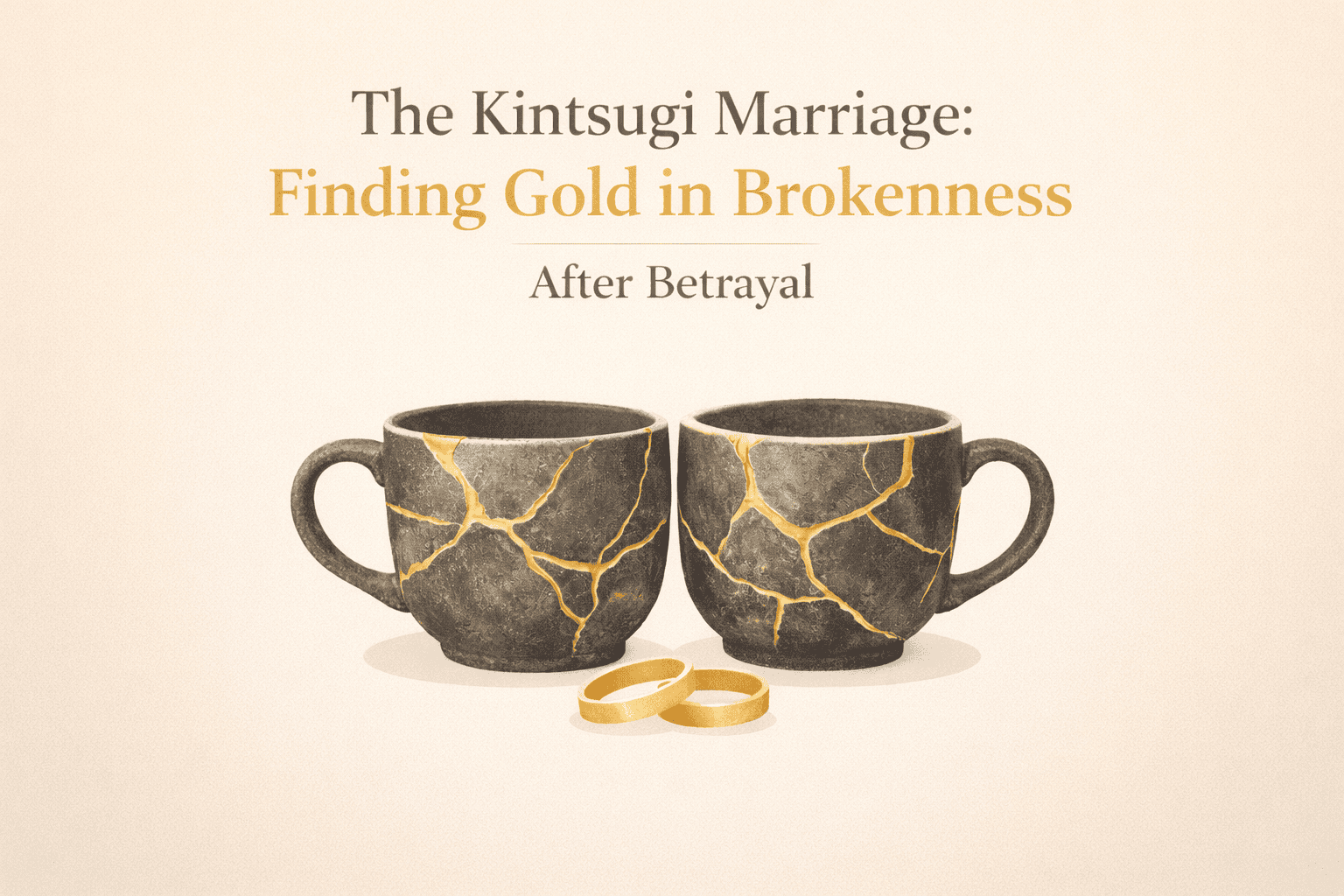
Kintsugi is the Japanese art of repairing broken pottery with gold, treating the fracture as part of the object’s history rather than a flaw to be hidden. Applied to a marriage after betrayal, it proposes something specific: the goal is not restoration to what was before, as though the break never happened, but transformation into something that honors the fracture and is more beautiful because of it.
If you are holding the pieces of a marriage after infidelity, wondering whether anything good can come out of this, the kintsugi framework offers theological grounding and a particular kind of hope. The fractures do not disqualify your marriage from beauty. They may become its most distinctive feature.
The short version: a kintsugi marriage does not pretend the betrayal away, and it does not return to what it was. It integrates the wound. Research on relationally betrayed women found post-traumatic growth across all five measured dimensions — including spiritual change — making this more than a metaphor.
Quick answers
What is a kintsugi marriage?
A marriage rebuilt after betrayal in a way that acknowledges the break rather than concealing it. The repair itself becomes part of the marriage’s story, in the same way gold seams become part of a repaired bowl.
Is there research behind this?
Yes. A 2017 study of 202 relationally betrayed women found the majority reported growth across all five measured dimensions: new possibilities, relating to others, personal strength, spiritual change, and appreciation of life. The authors concluded growth after this kind of betrayal is not merely possible but likely.
Does this mean the betrayal was good?
No. It would have been better if the bowl had never broken. The framework offers a way forward after the break has happened. It is not a justification for the breaking.
How long does it take?
Longer than most couples expect — years rather than months. In the research, the factor most associated with growth was the passage of time.
The art and the philosophy
Kintsugi — 金継ぎ, “golden joinery” — emerged in 15th-century Japan. The traditional account holds that a shogun sent a damaged tea bowl to China for repair and was dismayed by the ugly metal staples that came back. Japanese craftsmen developed an alternative: lacquer mixed with powdered gold, silver or platinum, filling the break rather than clamping it shut.
Three ideas sit underneath the practice.
Wabi-sabi — beauty in imperfection and impermanence. A kintsugi bowl is not fixed so its damage disappears. It is valued for the history the damage records.
Mottainai — regret over waste. Rather than discarding a broken vessel, kintsugi honors its worth by spending precious material on its repair.
Mushin — acceptance of change. The repaired object is not a lesser version of the original. It has entered a different phase of its existence with a beauty of its own.
The finished piece is frequently valued above the unbroken original. The gold seams become a map of where the object has been.
Four principles for a marriage
The break is acknowledged, not hidden
A great deal of affair-recovery advice implicitly aims at getting back to normal — behaving as though the break did not occur. Kintsugi rejects that outright. The break happened. It changed things permanently. Concealing it builds a facade that tends to give way under the next pressure.
A kintsugi marriage carries the betrayal as part of its history. That does not mean constant discussion or perpetual punishment. It means honest integration rather than suppression.
Precious material fills the cracks
The gold in kintsugi is not cheap filler. It is costly, and the cost is the point. What fills the cracks in a betrayed marriage has to be equally substantive: genuine repentance rather than regret, consistent honesty sustained over time, patient rebuilding of safety, love that costs the one giving it, and grace freely given but never cheaply demanded.
Quick fixes, thin apologies and pressure to move on are glue on a tea bowl. The repair does not hold and no transformation occurs.
The result is different, not inferior
A kintsugi bowl is not a failed attempt at an unbroken bowl. It is a different kind of beautiful, one that could not have existed without the break.
Couples who do the long work of genuine repair often say that years later their marriage has qualities it never had before — deeper communication, greater intentionality, harder-won trust. That report is no longer only anecdotal.
In 2017, Deb Laaser and colleagues published a study of 202 relationally betrayed women in the Journal of Marital and Family Therapy. The distress findings were severe: 96 percent described the betrayal as very traumatic, and more than half named it the most traumatic event of their lives. But the majority of the same women also reported post-traumatic growth, and across every dimension the researchers measured — new possibilities, relating to others, personal strength, spiritual change, and appreciation of life. The authors’ conclusion was that growth after this kind of betrayal is not merely possible but likely.
Two things are worth saying carefully about that. It does not mean betrayal causes growth, and the study measures association rather than causation. It does not mean growth is owed to you on a schedule. What it does establish is that the pattern is real, it is common, and one of its five dimensions is spiritual — which is precisely what this framework has been claiming.
The strongest correlate of that growth was the passage of time.
Redemption is not erasure
This does not make the betrayal good or necessary. It means redemption is possible, which is a different claim and a better one.
Why kintsugi resonates theologically
Resurrection, not resuscitation. Christianity does not promise that broken things return to their former state. It promises something more radical — death, then something new. The resurrected Christ still bore the wounds of crucifixion, transformed, no longer sources of death but markers of victory. A kintsugi marriage is resurrected rather than resuscitated. It does not come back as it was.
Beauty for ashes. Isaiah 61:3 speaks of beauty given for ashes, the oil of joy for mourning. That is kintsugi language. The ashes do not disappear. They become material for something else.
Redemption reframes rather than deletes. Joseph’s brothers meant evil against him, and God used it for good (Genesis 50:20). The cross was an instrument of execution before it was an instrument of salvation. The betrayal was wrong, and it can be woven into a testimony. Both halves of that sentence have to stay.
Strength surfacing through weakness. Paul’s paradox in 2 Corinthians 12:10 — when I am weak, then I am strong — sits close to the kintsugi idea. The cracks are not hidden as shameful. They are highlighted, because they show where strength emerged.
An important limit. This framework applies to marriages where both partners are committed to the work. It does not obligate anyone to remain in an unsafe situation, and no theology of redemption requires you to stay where you are being harmed. If you are afraid of your husband, that is a different situation with different answers — the National Domestic Violence Hotline is available 24/7: call 1-800-799-7233, text START to 88788, or chat at thehotline.org.
What a kintsugi marriage is not
The framework can be misapplied, and the misapplications do real damage.
It is not minimizing. “It’s fine because we’ll come out stronger” is not kintsugi. It is spiritual bypassing wearing the metaphor as a costume. The break is still a break, and honest acknowledgment of the damage has to come before anything else.
It does not require reconciliation. Not every marriage can or should be repaired. Some breaks are too severe. Sometimes one partner refuses the costly work. The framework describes what is possible where both commit — it does not create an obligation.
It cannot be rushed. Real kintsugi repair takes weeks as each layer of lacquer cures. Marriage restoration after betrayal runs on a similar logic and a longer clock. Rushing produces a fragile repair, not gold.
It does not glorify the breaking. The beauty of a repaired bowl does not make shattering it a good idea. It would have been better for the bowl never to break.
The five phases
Drawn from the actual repair process, and mapping onto the stages of betrayal trauma recovery.
1. Gathering the pieces
The craftsman collects every shard, including the small ones. In a marriage this means facing the full extent of what broke — the whole scope of the betrayal, the damage to trust, the wounds. Attempting repair while pieces remain hidden guarantees an incomplete result, which is why staggered disclosure is so corrosive.
2. Cleaning and assessment
Each piece is cleaned and examined. How deep are the fractures, and what can be repaired? Couples need an honest assessment of the damage, and this is usually where professional help becomes necessary rather than optional. Betrayal trauma is a clinical specialty, and the credentials are worth understanding before you choose.
3. Careful reassembly
Lacquer and gold are applied, each piece positioned and held. This is painstaking, unglamorous work. In a marriage it is the long middle — consistent honesty, patient rebuilding, a great many small choices that move broken pieces back toward each other.
Timing matters here more than couples expect. Joint work attempted before the betrayed partner has any stability of her own tends to go badly, for reasons that are clinical rather than spiritual.
4. Curing and strengthening
Kintsugi lacquer needs weeks in a humid environment to harden properly, and rushing ruins it. Marriage restoration likewise needs time for new patterns to set and for trust to rebuild through demonstrated reliability. This is the phase where most couples want to declare themselves finished, and where finishing early costs the most.
5. Revealing the gold
The excess lacquer is removed and the seams appear. In a marriage this arrives when the couple can look at their history, betrayal included, and see it integrated into a story rather than hanging over one. The scars stay visible. They have become gold.
Living it
Couples who take this framework seriously tend to describe a few things in common.
They speak honestly about their story — not hiding the betrayal, not defined by it either. They recognize that their marriage’s beauty includes what they came through. They extend to each other the grace they have received: the betrayed partner practicing ongoing forgiveness, the unfaithful partner practicing ongoing humility. And they hold the marriage as something precious, having very nearly lost it.
The gold-filled cracks become testimony — to each other, to their children, and to a community that mostly assumes marriages like theirs quietly end.
The 12-week framework
Faith-integrated healing after betrayal needs both theological grounding and practical structure. Rebuilding Sacred Intimacy: A Kintsugi Couples Workbook is a 12-week program that weaves clinical insight with biblical honesty — no platitudes, no spiritual bypassing.
Scripture integration through each phase, prayers for both partners, and a framework for the sacred dimension of restoration. Written by a couple who walked this road.
Frequently asked questions
What is a kintsugi marriage?
A marriage rebuilt after betrayal in a way that acknowledges the break rather than concealing it. Drawing on the Japanese art of repairing pottery with gold, the framework treats the fracture as part of the object’s history. The goal is not a return to how things were before but transformation into something that integrates the wound.
Is there research supporting the idea that growth follows betrayal?
Yes. A 2017 study by Laaser and colleagues in the Journal of Marital and Family Therapy examined 202 relationally betrayed women and found the majority reported post-traumatic growth across all five measured dimensions: new possibilities, relating to others, personal strength, spiritual change, and appreciation of life. The authors concluded such growth is not merely possible but likely. The strongest correlate was the passage of time.
How long does it take to reach this point?
Longer than most couples expect, and measured in years rather than months. Early stages focus on safety and stabilization, with integration arriving much later. In the research, growth was significantly associated with the passage of time, which suggests patience is doing more work than technique.
What if my spouse is not committed to the process?
The framework requires both partners. Where one refuses the costly work of consistent honesty, patient rebuilding and genuine change, it cannot be applied by force. Your own healing does not depend on that decision, and a great deal of recovery from betrayal trauma happens in individual work regardless of what a partner chooses.
Does the kintsugi framework apply if the marriage does not survive?
The metaphor primarily describes marriages being rebuilt, but its principles apply to individual restoration as well. A life can be broken and the breaking can be integrated into a transformed story. The gold can appear in personal healing even where a marriage is not restored.
Is this just positive thinking about betrayal?
No. Kintsugi does not minimize the break, it highlights it with precious material. The framework requires honest acknowledgment of damage before any transformation is possible. Positive thinking skips grief. This moves through it.
Does this mean the betrayal was part of God’s plan?
The framework does not claim the betrayal was good or necessary. The biblical pattern it draws on, such as Genesis 50:20, holds two things together: what was intended for harm was harm, and God can work redemption through it. Both halves of that statement matter, and collapsing them into one is where spiritual bypassing begins.
A note on what this is. We are not therapists, and this article is educational and theological rather than clinical. Nothing here is a diagnosis, a treatment plan, or a substitute for care from a qualified professional. Research findings are attributed to their authors and were verified against published sources in July 2026.
If you need help right now. If you are in physical danger from your partner, or afraid of him, the National Domestic Violence Hotline is available 24/7 — call 1-800-799-7233, text START to 88788, or chat with an advocate at thehotline.org. If you are having thoughts of harming yourself, call or text 988 in the U.S. to reach the Suicide & Crisis Lifeline.
If your phone or computer may be monitored, consider using a device he does not have access to, and clearing your browser history afterward. The hotline can also be reached by TTY at 1-800-787-3224.