
You’ve heard that EMDR can help with trauma, but the idea of processing memories through eye movements sounds strange—maybe even too good to be true. The skepticism is fair. And yet EMDR for betrayal trauma has become one of the most researched and validated treatments available, with specific applications for infidelity that traditional talk therapy cannot match.
Understanding what EMDR actually involves, how it works for betrayal specifically, and what you can realistically expect helps you decide whether this treatment belongs in your recovery. This is not magic. But it is effective in ways that consistently surprise the people who try it.
What EMDR Actually Is
Eye Movement Desensitization and Reprocessing was developed by psychologist Francine Shapiro in the late 1980s. The core insight: traumatic memories get stored differently than ordinary memories. They remain raw, unprocessed, capable of triggering emotional flooding years after the event. The Cleveland Clinic’s overview of EMDR describes it as a treatment that helps your brain resume its natural healing process by changing the emotions, thoughts, and behaviors tied to distressing experiences.
The bilateral stimulation component—usually guided eye movements, but sometimes alternating taps or sounds—appears to activate the brain’s information processing system. This allows traumatic memories to integrate into your broader life narrative rather than remaining as isolated, hair-trigger detonators.
EMDR is not hypnosis. You remain fully conscious and in control throughout. You will not blurt out things you don’t want to say. You will not lose awareness of your surroundings. You will remember everything.
That transparency is part of why EMDR for betrayal trauma appeals to people who’ve had enough of feeling out of control.
Why EMDR for Betrayal Trauma Is Different from Talk Therapy
Betrayal trauma creates specific kinds of memory disruption that talk therapy addresses slowly—if at all. The moment of discovery often gets seared into memory with photographic intensity. A particular song. The way light fell through the window. The exact words on that text message. These fragments replay on a loop, triggering emotional flooding as intense as the original discovery.
EMDR addresses this by allowing you to process the traumatic memory without being overwhelmed by it. The bilateral stimulation appears to prevent the flooding that normally happens when you revisit the memory, creating conditions where your brain can actually process what happened. Think of it as defusing a bomb: the memory remains, but its explosive charge dissipates.
Betrayal also installs negative beliefs about yourself that become deeply embedded: “I’m not enough.” “I can’t trust my own judgment.” “I’m unlovable.” EMDR protocols specifically target these shame-based conclusions, replacing them with more accurate beliefs that your rational mind already knows but your body hasn’t accepted.
And if you’re thinking, “I already know I’m not to blame—so why do I still feel like I am?”—that gap between knowing and feeling is exactly what EMDR is designed to close.
The Eight Phases of EMDR Treatment
EMDR follows a structured eight-phase protocol. Knowing what each phase involves removes the mystery.
Phase 1: History and Treatment Planning. Your therapist gathers detailed history, identifies specific memories to target, and assesses your readiness. For betrayal trauma, this includes the discovery moment, specific incidents, and your most persistent triggers.
Phase 2: Preparation. Before any processing begins, you learn coping skills for managing distress during and between sessions—grounding techniques, safe place visualization, containment exercises. This phase is essential, not optional. Your therapist will not proceed until you have adequate stabilization resources.
Phase 3: Assessment. For each memory target, you identify the specific image, the negative belief you hold about yourself in relation to it, the positive belief you’d prefer, and your current disturbance level on a 0–10 scale.
Phase 4: Desensitization. This is where bilateral stimulation happens while you focus on the traumatic memory. The therapist guides you through sets of eye movements, pausing periodically to check what’s coming up. New memories, emotions, body sensations, or insights often emerge—and that’s the processing working.
Phase 5: Installation. Once the disturbing memory’s charge has reduced, the positive belief is strengthened. The goal is for the new belief to feel as viscerally true as the negative one once did.
Phase 6: Body Scan. You scan your body for any remaining tension or distress related to the memory. If physical sensations persist, additional processing targets them. This phase matters because trauma lives in the body, not just the mind.
Phase 7: Closure. Each session ends with stabilization to ensure you leave feeling contained. If processing is incomplete, the therapist helps you put the material away safely until next time.
Phase 8: Reevaluation. Subsequent sessions begin by checking previously processed material. Sometimes additional work is needed; sometimes the change has held and new targets can be addressed.
What a Typical EMDR Session Looks Like
A standard session lasts 60 to 90 minutes—longer than typical therapy to allow adequate processing time. You sit facing your therapist, who guides you through the protocol.
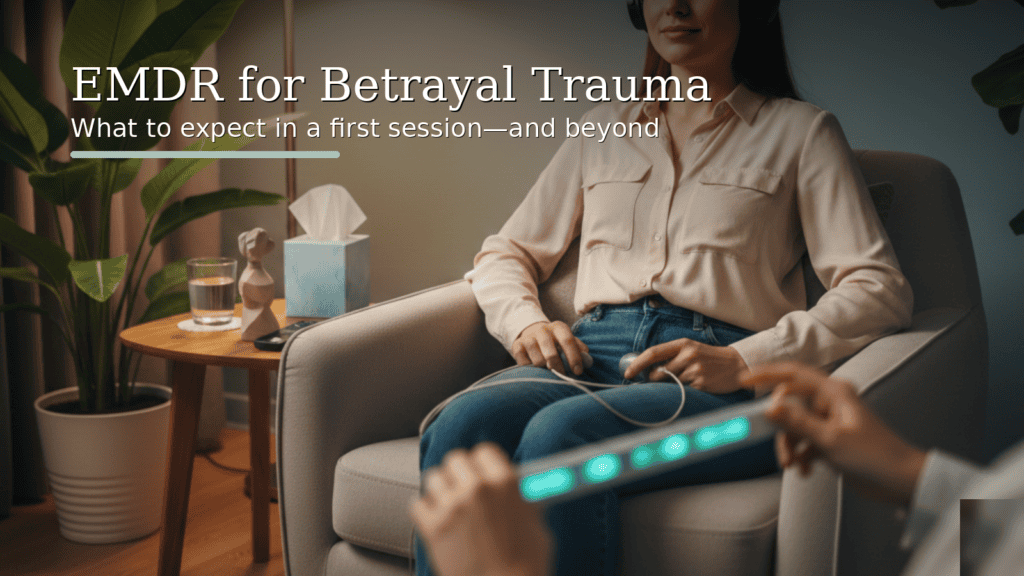
During bilateral stimulation, you might follow the therapist’s fingers moving back and forth, hold buzzers that alternate vibration in each hand, or wear headphones with tones alternating between ears. The specific method matters less than the left-right alternation pattern.
You focus on the target memory while bilateral stimulation occurs, typically for 30 seconds to a minute. Then you pause, take a breath, and report what came up—images, emotions, physical sensations, new thoughts. The therapist follows your lead, processing whatever emerges.
The experience varies widely. Some people feel intense emotions during processing. Others report the memory seeming to recede, becoming less vivid. Some describe watching the memory like a movie rather than reliving it. All of these responses are normal. There is no single “right” way to experience EMDR for betrayal trauma — your processing will look like yours.
What EMDR for Betrayal Trauma Specifically Targets
The discovery moment. For many betrayed partners, the instant of discovery is the most traumatic memory they carry—the text you saw, the conversation you overheard, the evidence you found. EMDR can reduce this memory’s intensity so it no longer hijacks your entire nervous system.
Intrusive images. Many betrayed partners are tormented by mental images of their spouse with the affair partner—whether based on evidence or imagined. These images play on repeat. EMDR can process them, reducing both frequency and intensity.
Earlier wounds. Betrayal often reactivates attachment wounds from childhood or previous relationships. EMDR can address these earlier experiences that amplify the current trauma and distort your perception of the present.
Triggers. Specific locations, songs, times of year, or sensory reminders that currently provoke overwhelming distress can be individually targeted and processed.
Negative self-beliefs. The shame narratives that betrayal installs—“I should have known,” “I wasn’t enough,” “Something is wrong with me”—are directly targeted through the installation phase.
How Long EMDR for Betrayal Trauma Takes
Single-incident traumas sometimes resolve in as few as three to six sessions. Betrayal trauma is rarely a single incident. It typically involves multiple traumatic moments—discovery, trickle-truth revelations, confrontations, ongoing triggers. Research compiled by EMDRIA confirms that complex trauma requires more sessions than single-event trauma.
A typical course of EMDR for betrayal trauma might involve 8 to 20 sessions, though this varies based on the complexity of your situation, your trauma history, and how quickly you process. Some people need more. Some need fewer. Your therapist will assess as you go.
EMDR is often integrated with other therapeutic approaches rather than used alone. Your therapist might use EMDR for specific trauma processing while also doing talk therapy for other aspects of recovery. The two modalities complement each other.
What EMDR Can and Cannot Do
EMDR can reduce the emotional intensity of traumatic memories, help you think about what happened without being overwhelmed, shift the negative self-beliefs betrayal installed, decrease hypervigilance, and improve your capacity for emotional regulation. Those are significant gains.
EMDR cannot make you forget what happened. The memories remain—but they lose their detonating power. You will still know your spouse betrayed you. You simply will not be emotionally hijacked every time you think about it.
EMDR cannot repair your relationship. It addresses your individual trauma symptoms. Relationship repair requires additional work—your spouse’s accountability, communication rebuilding, trust restoration—that the Gottman Institute’s affair recovery framework identifies as separate phases requiring their own dedicated effort.
EMDR cannot make decisions for you. After processing, you may find far greater clarity about whether to stay or leave—but the treatment doesn’t determine that outcome. What it does is remove the trauma fog that makes clear thinking so difficult. Decisions made from clarity are better decisions.
Finding an EMDR Therapist Trained in Betrayal Trauma
Not all EMDR therapists have specific experience with betrayal. The ideal is someone trained in both EMDR and partner trauma—an EMDR-certified therapist who also holds APSATS credentials. The EMDRIA therapist directory lists certified practitioners searchable by location and specialization.
Cross-reference with the APSATS specialist directory to find clinicians who hold both certifications. When interviewing potential therapists, ask specifically about their experience treating betrayal trauma and how they integrate EMDR into that work. The combination of technical EMDR skill and betrayal-specific clinical understanding produces the best outcomes.
Online EMDR has become increasingly common and can be effective. If no local therapist has the right combination of training, telehealth significantly expands your options.
The investment in finding someone properly credentialed for EMDR for betrayal trauma pays for itself in sessions you won’t waste with the wrong provider.
Preparing for Your First EMDR Session
Before processing begins, your therapist will ensure you have adequate coping resources. You’ll learn grounding techniques to use if you become overwhelmed—both during sessions and between them. You’ll develop a mental “container” for setting aside distressing material until the next session.
Plan for emotional fatigue afterward, especially early on. Don’t schedule demanding obligations immediately after sessions. Some people feel tired, emotionally raw, or have vivid dreams following processing. This typically decreases as treatment continues.
Keep a journal between sessions. New memories, insights, or connections often surface after processing, and recording them helps you bring useful material to subsequent sessions.
Most people who try EMDR for betrayal trauma wish they had started sooner. The anticipation is almost always worse than the experience.
Frequently Asked Questions
Is EMDR safe?
EMDR is considered one of the safest trauma treatments available. It is recommended by the American Psychological Association, the World Health Organization, the International Society for Traumatic Stress Studies, and the Department of Veterans Affairs for trauma treatment. Working with a properly trained and certified therapist is essential.
What if I can’t do eye movements?
Bilateral stimulation can be achieved through alternating taps, sounds through headphones, or handheld buzzers. Eye movements are the most common method but not the only option. The alternating pattern matters more than the specific modality.
Can EMDR be done with couples together?
Some therapists use EMDR in couples sessions, having one partner witness the other’s processing. This can build empathy and understanding. However, it requires specialized training and should only happen after both partners have completed individual stabilization. It is not a starting point. Individual EMDR for betrayal trauma should be well underway before any couples processing is considered.
What if EMDR brings up worse memories?
Processing one memory sometimes activates related ones. This is normal and actually part of the healing—your brain is connecting and integrating material that was previously fragmented. Your therapist will help you process whatever emerges. The preparation phase ensures you have tools to manage distress between sessions.
How does EMDR for betrayal trauma differ from EMDR for other traumas?
The protocol is the same, but the targets are specific to infidelity: discovery memories, intrusive images of the affair, shame-based beliefs about yourself, and the particular triggers that betrayal creates. A therapist trained in both EMDR and betrayal trauma understands which targets to prioritize and how to sequence the work.
Take the Next Step
EMDR for betrayal trauma can significantly accelerate your individual healing. But comprehensive recovery also requires daily, guided effort for the relational work that individual therapy doesn’t address. Rebuilding Sacred Intimacy: A Kintsugi Couples Workbook offers a 12-week framework that bridges the gap between clinical treatment and the intimacy rebuilding that happens between sessions.
The workbook integrates polyvagal science with faith—providing grounding techniques, communication tools, and a structured Sensate Focus Framework designed for couples healing after betrayal. It gives you something concrete to practice together at whatever pace your recovery allows.
Rebuilding Sacred Intimacy
Where fractures become gold.
Disclaimer: This content is for educational purposes only and is not a substitute for licensed professional therapy. The authors are not therapists or counselors—we write from lived experience and research, not clinical authority. If you or your spouse are in crisis, please contact a licensed betrayal trauma therapist, an APSATS-certified provider (apsats.org), or call 988 (Suicide & Crisis Lifeline). Nothing in this article should be interpreted as medical, psychological, or legal advice.
About the Author: The Sullivan’s writes from both sides of betrayal—as the partner who caused the wound and the partner who helped rebuild from it. Together with his wife, they created Rebuilding Sacred Intimacy to address the gap between faith-based resources that skip the body and clinical resources that ignore the soul. Their approach to answering questions about the affair, managing triggers, and rebuilding physical intimacy integrates polyvagal neuroscience with Christian theology, informed by the Gottman Method and trauma-informed clinical practice.
Credentials: Lived experience, extensive research in polyvagal theory and attachment repair, APSATS-informed framework
