
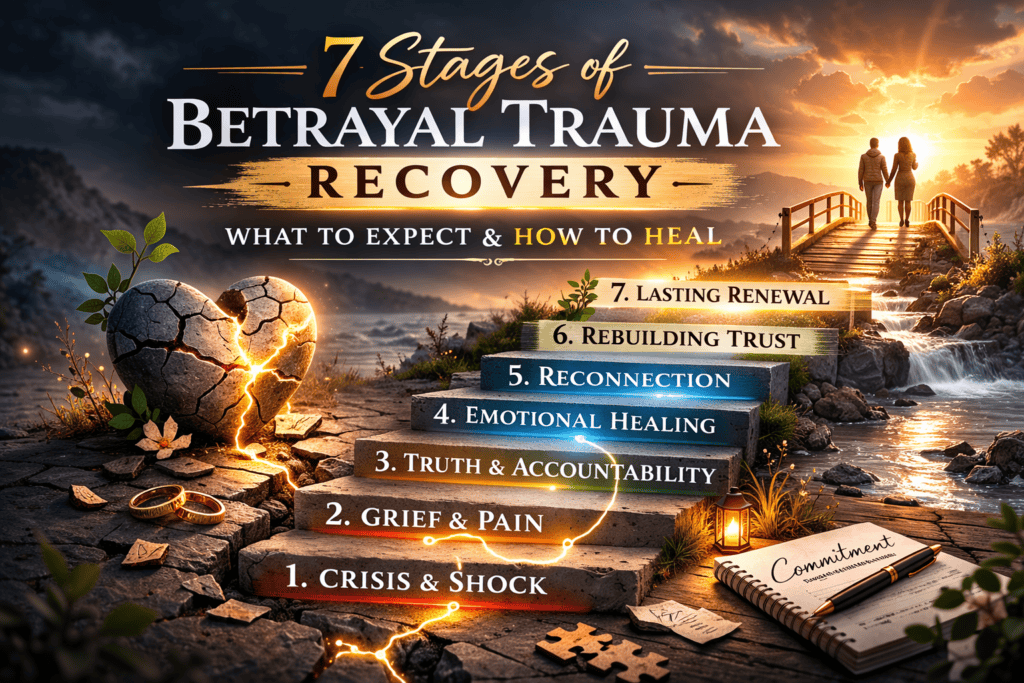
The stages of betrayal trauma recovery follow a recognizable pattern—though the journey through them is rarely linear. Understanding these stages provides a framework for the chaos. It helps set realistic expectations, and it offers something essential in the early months: assurance that what you are experiencing is part of a recognizable healing process, not evidence that you are broken or failing.
We know these stages from the inside. We lived them—separately and together—over years of our own recovery. What we can tell you from the other side is this: the stages are real, the timeline is longer than anyone wants, and the growth on the other side is deeper than we imagined possible. Most couples who do the sustained work move through these stages over two to five years, cycling back through earlier ones as new aspects of healing emerge.
“He heals the brokenhearted and binds up their wounds.” — Psalm 147:3
The 7 Stages of Betrayal Trauma Recovery at a Glance
Before we walk through each stage in detail, here is the full map. Your journey will not follow this table in a straight line—but the stages themselves are consistent across nearly every couple navigating betrayal trauma.
| Stage | Focus | What It Looks Like | Typical Duration |
| 1. Crisis | Survival | Shock, flooding, inability to function | Days to weeks |
| 2. Grief | Emotional processing | Waves of rage, sadness, numbness | 3–12 months |
| 3. Investigation | Narrative building | Compulsive questions, checking, research | 1–6 months |
| 4. Meaning-Making | Identity reconstruction | “Why” questions, faith wrestling | 6–18 months |
| 5. Boundaries | Rebuilding safety | Transparency protocols, accountability | 12–24 months |
| 6. Reconnection | New relationship | Genuine connection, renewed intimacy | 12–36 months |
| 7. Integration | Post-traumatic growth | Story without flooding, helping others | 2–5+ years |
Stage 1: Crisis and Discovery
The discovery of betrayal initiates acute crisis. Whether disclosure was voluntary or discovered, this stage involves the immediate aftermath—when the world as you understood it has shattered and nothing feels real.
What This Stage Looks Like
Shock. Disbelief. Emotional flooding. Physical symptoms—nausea, inability to eat or sleep, chest tightness, trembling. You oscillate between demanding every detail and being unable to hear another word. Normal life feels impossible. Your nervous system has detected a catastrophic threat to attachment, and it has activated every alarm it has.
What Helps During Crisis
- Basic survival: eating even when not hungry, sleeping even if chemically assisted temporarily
- Having at least one safe person who knows what is happening
- Not making permanent decisions while in acute crisis
- Understanding that your reactions are normal trauma responses, not weakness
Common duration: Days to weeks for acute crisis. Reverberations continue for months.
Stage 2: Grief and the Emotional Roller Coaster
As initial shock recedes, the reality of loss becomes present. This is not just grief for what happened. It is grief for the relationship you thought you had, the history that now looks different, and the future you had imagined.
What This Stage Looks Like
Intense waves of emotion arrive without warning. Good hours followed by devastating hours. Anger, sadness, fear, and numbness rotate unpredictably. Intrusive thoughts and mental images play on a loop you cannot control. Research from the Gottman Institute confirms that this emotional volatility is a hallmark of betrayal trauma, not emotional instability.
What Helps During the Grief Stage
- Allowing waves of emotion without judgment—they are processing, not pathology
- Understanding that emotional roller coasters are normal, not evidence of instability
- Beginning individual therapy with a betrayal trauma specialist (APSATS-certified providers specialize in this work)
- Journaling or other emotional processing practices
Common duration: 3–12 months, with intensity gradually decreasing.
Stage 3: Obsession and Investigation
Many betrayed partners move through a phase of intense need for information. This is not unhealthy curiosity. It is the mind’s attempt to create a coherent narrative from fragments of truth and deception. The brain cannot rest until the story makes sense.
What This Stage Looks Like
Compulsive questions about the affair. Need for detailed timelines. Checking phones, accounts, and locations. Researching the affair partner. Replaying events trying to separate what was real from what was performance. The nervous system is building a threat map—it needs data to know where danger lives.
What Helps During the Investigation Stage
- Structured therapeutic disclosure—a formal process for sharing information with professional guidance
- Recognizing the difference between information that helps create narrative and information that creates additional trauma
- Setting boundaries around questioning while honoring the legitimate need for truth
Common duration: 1–6 months, often overlapping with Stage 2.
Stage 4: Meaning-Making and Identity Reconstruction
Beyond the immediate crisis lies the work of making sense of what happened. This stage involves reconstructing your understanding of the past, your partner, yourself, and your future. The questions shift from “what happened” to “why” and “what does this mean about me.”
What This Stage Looks Like
Examining your own history, attachment patterns, and vulnerabilities. Wrestling with faith questions—How could God let this happen? Where was He? Is this marriage still sacred? Considering whether reconciliation is possible or desired. The identity you built around this relationship has fractured, and a new one must be constructed.
What Helps During Meaning-Making
- Individual therapy exploring your story beyond the betrayal—patterns, attachment history, family of origin
- Couples therapy if both partners are committed to the work
- Faith processing with trauma-informed spiritual support—not platitudes, but honest wrestling
- Connecting with others who understand: support groups, trusted friends who will not minimize
Common duration: 6–18 months, overlapping with other stages.
“To bestow on them a crown of beauty instead of ashes, the oil of joy instead of mourning.” — Isaiah 61:3
Stage 5: Boundary Setting and Rebuilding Safety
Genuine healing requires establishing new patterns of safety. This involves clear boundaries, accountability structures, and observable change—not promises. The betrayed partner’s nervous system needs evidence, not words. This is one of the most critical stages of betrayal trauma recovery because safety is the prerequisite for everything that follows.
What This Stage Looks Like
Defining what transparency and honesty look like in practice. Establishing accountability measures—access to devices, location sharing, structured check-ins. Setting consequences for continued deception. Creating agreements about triggering situations. The relationship is being rebuilt with new architecture.
What Helps During Boundary Setting
- Clear, written agreements that both partners understand and commit to
- Understanding that boundaries are not punishment—they are protection that allows trust to slowly rebuild
- Professional guidance in creating sustainable accountability structures
Common duration: Ongoing for 12–24 months, with structures gradually relaxing as trust rebuilds.
Stage 6: Reconnection and Building a New Normal
With safety established and individual healing progressing, couples can begin building a new relationship. Not restoring the old one—creating something that acknowledges what happened while growing beyond it. This is the kintsugi stage: the gold goes into the cracks.
What This Stage Looks Like
Moments of genuine connection increasing in frequency. Ability to discuss the betrayal without complete destabilization. Renewed physical intimacy—approached gradually and with trauma-informed care. Shared activities and future planning. Laughter returning, not forced but real.
What Helps During Reconnection
- Couples therapy focused on rebuilding rather than crisis management
- Sensate focus therapy for gradual, safe physical reconnection
- Continued individual work alongside couples work
- Patience with setbacks—they are normal and do not erase progress
Common duration: 12–36 months.
Stage 7: Integration and Post-Traumatic Growth
The final stage of betrayal trauma recovery is not “getting over it.” It is integrating the experience into your life story. The betrayal becomes part of your history without dominating your present. Some couples discover growth that would not have occurred without the crisis—deeper honesty, stronger connection, more intentional love.
What Integration Looks Like
Ability to tell your story without emotional flooding. The betrayal informs but does not define your relationship. Genuine forgiveness—not forced or premature, but real. Recognition of growth that emerged from the crisis. Capacity to help others on similar journeys. The scars are visible. They are filled with gold.
What Helps During Integration
- Continued maintenance of healthy communication and transparency patterns
- Ongoing connection practices that have become part of your rhythm
- Spiritual meaning-making—finding redemption in the story, not erasing the story
- Sharing your experience when appropriate—therapeutic for you and helpful for others
Timeline: 2–5+ years from discovery, with growth continuing indefinitely.
“Behold, I am making all things new.” — Revelation 21:5
What You Need to Know About These Betrayal Trauma Stages
Healing is not linear. You will cycle back through stages of betrayal trauma recovery, sometimes triggered by anniversaries, new discoveries, or life transitions. Returning to an earlier stage does not mean you have failed. It means you are human, and your nervous system is processing at its own pace.
Both partners have work to do. While these stages describe the betrayed partner’s journey, the unfaithful partner has their own parallel work: understanding how they became capable of betrayal, addressing underlying patterns, and actively supporting their partner’s healing.
Not all couples reconcile—and that is okay. Moving through these stages may bring clarity that the relationship cannot be rebuilt. This is a valid outcome. Healing does not require reconciliation. Sometimes the bravest thing is recognizing what cannot be repaired.
Frequently Asked Questions About Stages of Betrayal Trauma Recovery
How long does betrayal trauma recovery take?
Most couples who successfully reconcile describe a two-to-five-year journey for substantial healing, with continued growth beyond that. Acute symptoms typically improve within six to eighteen months. Full integration—where betrayal is part of your story without dominating it—usually requires several years of sustained work.
Is it normal to feel like I am going backward?
Completely. Returning to earlier stages of betrayal trauma recovery—especially during anniversaries, triggered moments, or new disclosures—is expected. Progress is not erased by setbacks. The overall trajectory matters more than any single difficult day.
When should we start couples therapy after betrayal?
Individual stabilization for the betrayed partner typically should occur before or alongside couples work. Starting couples therapy too early can cause additional harm. Many APSATS-certified specialists recommend the betrayed partner begin individual work first, with couples therapy beginning when acute crisis has stabilized—often two to six months post-discovery.
What if my partner is not doing their work?
Your healing can progress regardless of your partner’s choices. However, reconciliation requires both partners doing their respective work. If your partner remains unwilling to address underlying issues and actively support your healing, reconciliation becomes increasingly unlikely—and potentially inadvisable.
Professional Resources for Betrayal Trauma Recovery
The following organizations provide specialized support for couples and individuals navigating betrayal trauma:
- APSATS (Association of Partners of Sex Addicts Trauma Specialists): apsats.org — Directory of certified betrayal trauma therapists
- EMDRIA (EMDR International Association): emdria.org — Find EMDR-trained therapists for trauma processing
- Gottman Institute: gottman.com — Research-based resources on trust repair after affairs
- SAMHSA National Helpline: samhsa.gov — Free referrals and information (1-800-662-4357)
Take the Next Step
Navigating the stages of betrayal trauma recovery requires structured support. Rebuilding Sacred Intimacy: A Kintsugi Couples Workbook provides a 12-week program with specific exercises for each stage—from crisis stabilization through reconnection. Communication scripts, grounding techniques, accountability frameworks, and faith integration designed for where you actually are.
Written by a couple who walked every stage—from both sides of the betrayal. Practical guidance grounded in faith and neuroscience. Not theoretical distance.
Rebuilding Sacred Intimacy
Where fractures become gold.
Disclaimer: This content is for educational purposes only and is not a substitute for licensed professional therapy. The authors are not therapists or counselors—we write from lived experience and research, not clinical authority. If you or your spouse are in crisis, please contact a licensed betrayal trauma therapist, an APSATS-certified provider (apsats.org), or call 988 (Suicide & Crisis Lifeline). Nothing in this article should be interpreted as medical, psychological, or legal advice.
About the Author: The Sullivan’s writes from both sides of betrayal—as the partner who caused the wound and the partner who helped rebuild from it. Together with his wife, they created Rebuilding Sacred Intimacy to address the gap between faith-based resources that skip the body and clinical resources that ignore the soul. Their approach to answering questions about the affair, managing triggers, and rebuilding physical intimacy integrates polyvagal neuroscience with Christian theology, informed by the Gottman Method and trauma-informed clinical practice.
Credentials: Lived experience, extensive research in polyvagal theory and attachment repair, APSATS-informed framework
